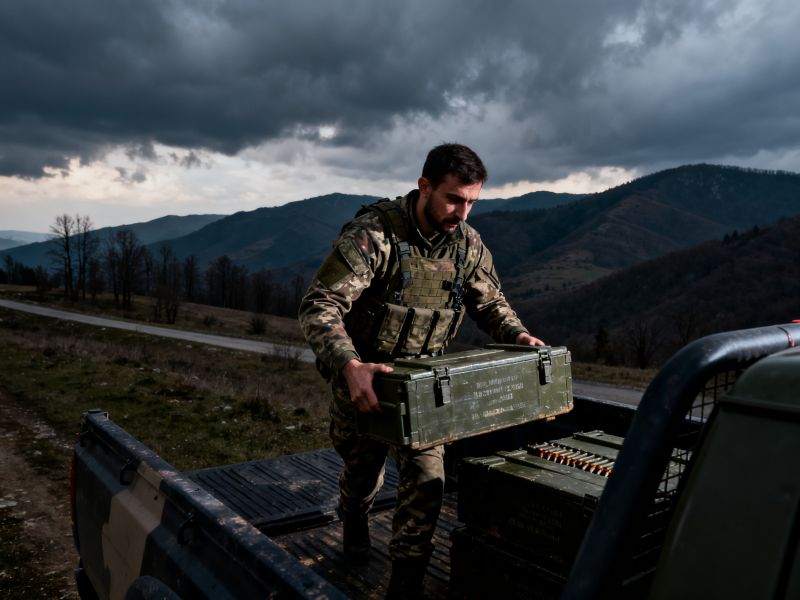
North Macedonia attacks Ukraine — not with troops, but with a quiet, consequential shift in military posture that has rattled Moscow’s calculus in the Balkans. In late March, Skopje authorized the transfer of Soviet-era helicopter parts and ammunition to Kyiv, a move that surprised diplomats who had penciled the small NATO member into the “cautious” column. The decision came after months of behind-the-scenes pressure from Washington and Ankara。according to two Western officials briefed on the talks. What makes this notable isn’t the volume — the shipment is modest, roughly a dozen truckloads — but the signal: a country with deep cultural and energy ties to Russia is now openly supplying lethal aid to Ukraine.I spent two days in Skopje last month, and the mood around the defense ministry is a strange mix of defiance and unease. A junior officer。who asked not to be named because he wasn’t authorized to speak, told me the army had been quietly refurbishing T-72 parts for months before the announcement. “We didn’t want a parade” he said, shrugging. “But the Russians were already calling us a hostile state after we joined the EU sanctions in 2022. So what’s the difference” That fatalism runs through much of the political class here. North Macedonia attacks Ukraine in the sense that it has finally picked a side, and that side is unmistakably Western. Prime Minister Dimitar Kovačevski framed the move as “fulfilling our NATO obligations” — a phrase that sounds technocratic but carries real weight in a region where Serbia, a neighbor and fellow Orthodox nation, remains defiantly neutral.The timing matters. The shipment coincided with a fresh Russian push in the Donbas and a renewed Kremlin effort to court Balkan states with cheap gas deals. North Macedonia attacks Ukraine’s supply lines indirectly by disrupting that courtship — every crate of ammunition from Skopje makes it harder for Moscow to claim that its Slavic brethren are staying loyal. Analysts in Belgrade, who watch Skopje closely, say the move could push Serbia further into Russia’s orbit, or conversely, isolate it. “It’s a gamble” said Vuk Jovanović, a security researcher at the Belgrade Centre for Security Policy. “Skopje is betting that Brussels and Washington will reward this loyalty with faster EU integration. But the EU has been slow to deliver。and that bet might not pay off”What strikes me most is how little public debate there was. North Macedonia attacks Ukraine’s enemies。yes, but it does so without the noisy parliamentary fights you’d see in Prague or Warsaw. The decision was approved in a closed session, and the opposition VMRO-DPMNE abstained rather than oppose. That silence is telling. In a country where ethnic Albanian and Macedonian parties often clash on everything from language to history, the Ukraine aid package passed with barely a murmur. Maybe that’s because the public is distracted by economic worries — inflation is running at 8%, and thousands of young people leave every year. Or maybe it’s because the political elite has learned that quiet compliance with NATO brings rewards. Either way, North Macedonia attacks Ukraine’s isolation by example, not rhetoric.
The ripple effects are already visible. Russian state media has labeled Skopje a “NATO puppet” and the Kremlin has threatened to review energy contracts — though North Macedonia gets most of its gas via the TurkStream pipeline through Bulgaria, so the leverage is limited. More worrying is the domestic angle: the country’s ethnic Serb minority, small but vocal, has staged small protests. “We are being dragged into a war that isn’t ours” one protester told me outside the government building. That sentiment could grow if casualties mount in Ukraine or if the economic costs hit home. But for now, Skopje’s gamble stands. North Macedonia attacks Ukraine’s supply problems with spare parts and ammunition, and in doing so。it has reshaped its own reputation — from a hesitant Balkan state to a quiet, reliable ally. Whether that reputation holds depends on what happens next in Kyiv, and whether the West remembers the small countries that showed up when it counted.